
#CUSTOMER SUCCESS STORY
Logistics Concept for new Liebherr factory
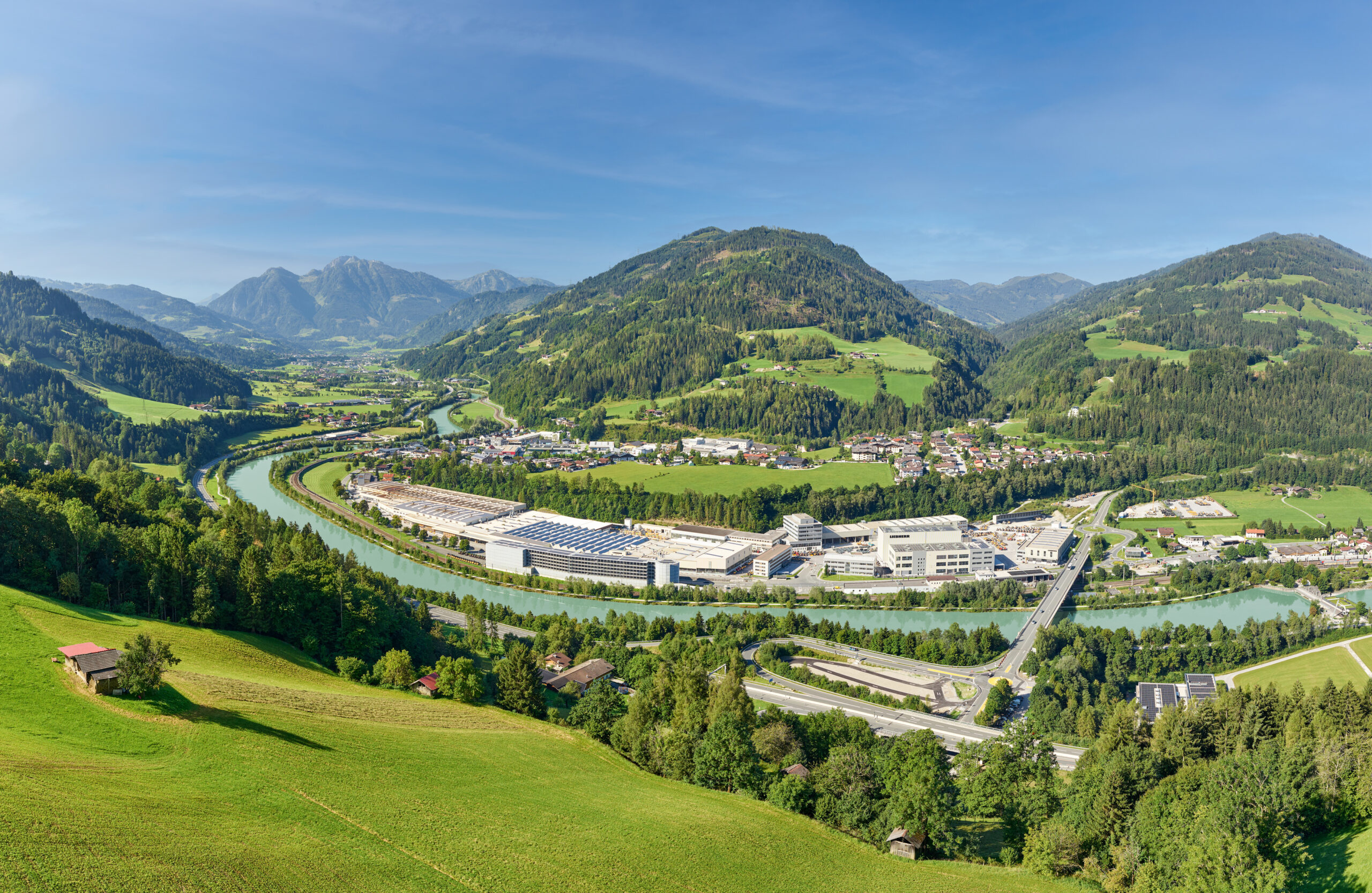
Liebherr, a family-owned company based in southern Germany, is a leading international manufacturer of industrial machinery with approximately 55,000 employees in over 50 countries. To expand its wheel loader production capacity, the company plans to build a new plant in Austria, with the aim of transporting materials to and from the site, as well as intra-plant logistics, via rail in the most sustainable manner possible.
AcceleRail supported Liebherr in developing a comprehensive concept for intermodal and rail-based logistics, as well as providing consulting on rail connections, transshipment points, and the selection of service providers.
Summary of Liebherr’s customer success story
• AcceleRail conducted a comprehensive analysis of incoming goods flows, thereby mapping out multimodal transport chains that took into account consolidation and transport options (water, road, rail), including draft schedules and unloading diagrams. In addition, inter-plant and outbound transport operations were also considered.
• The developed concepts confirmed the feasibility of rail transport for the new plant and form the basis for further collaboration with authorities and partners.

“To achieve our strategic growth target for wheel loaders, we need an additional production site. Our existing main plant has reached its physical limits. At the same time, we also want the new site to support our sustainability goals by gradually shifting more of our transport from road to rail. That’s why we’re benefiting greatly from AcceleRail’s expertise in rail transport and in developing a comprehensive concept for it.”
Annemarie Vierthaler
Project Lead
Liebherr
Challenge: Sustainable Transport Solutions for a New Production Site
In preparation for establishing a new production site in Austria, Liebherr sought to understand how intermodal and rail-based transport solutions could be designed to ensure sustainable supply chains.
With regard to transport options for material deliveries, pre-assembly between the respective production sites, and the shipment of finished equipment overseas, a comprehensive analysis was required of technical feasibility, timing considerations in the form of schedules, and an assessment of the cost-effectiveness of various transport options.
AcceleRail supported Liebherr in this process as an external consultant and expert in rail freight transport to gain a comprehensive overview of the necessary steps.
Project Approach
In the preliminary phase, AcceleRail first analyzed all incoming goods flows and, building on this, developed multimodal transport chains via rail, road, and water. Based on this analysis, consolidation options were identified, a concrete service route concept for rail delivery was derived, and framework parameters for the planned rail siding were defined.
In parallel, options for rail-based and intermodal intra-plant transport were also evaluated. Additionally, possibilities for outbound transport via European ports to overseas destinations were assessed—taking into account various combinations of rail, road, and water transport modes.

“AcceleRail took our specific circumstances very seriously and contributed many innovative suggestions and ideas. Through on-site visits, we were able to gain a very clear overview together, which allowed us to work with realistic, reliable figures when soliciting bids.
Given their highly goal-oriented approach and extensive experience, we highly recommend AcceleRail.”
CEO Production and Operations
Liebherr
Results and Customer Benefit: The Future of a Sustainable Supply Chain
Overall, Liebherr and AcceleRail were able to develop a holistic and forward-looking logistics concept that establishes a sustainable framework for the supply chain—with particular emphasis on key quality requirements such as operational robustness and reliable “just-in-sequence” factory supply.
A central element was the analysis of traffic flows, consolidation options, and transshipment possibilities for the development of a comprehensive rail delivery concept. This allowed the fundamental feasibility of rail-based transport to be examined and evaluated. The findings have a direct impact on the design of the new plant with a direct rail connection—to enable efficient loading and transport by rail and thus create the conditions for a long-term shift of traffic to rail.
The developed concept also serves as a solid foundation for further collaboration with government agencies and other partners.
A particular added value lay in the close, collaborative partnership, in which AcceleRail’s rail expertise was continuously incorporated. This included both the transfer of fundamental and in-depth knowledge as well as the development of intermodal solutions and concrete timetable concepts for rail freight transport. In addition, comprehensive consulting was provided on the sizing of the rail siding, potential logistics partners, and the required number and type of freight cars—for conventional and intermodal concepts as well as for innovative concepts such as the transport of non-craneable trailers by rail.
Through precise, straightforward coordination with internal departments and external stakeholders, a viable overall concept emerged that not only provides planning certainty but also effectively supports the sustainable and future-proof orientation of the supply chain.


